Waltz
~28–30 MPM · 3/4
Approximately 43–45 measures per 90-second heat. Current authored routine: 45 measures.
Pre-built choreography · Musical structure · Competition preparation
A complete pre-built competition choreography presented as a musical-bar map. Follow the authored sequence from opening through the final pose. Pre-Bronze source figures are displayed in the unified Bronze category.
| Seq | Figure / Combination | Level | Measures | Musical Bars | Cumulative |
|---|
This page preserves the supplied sequence, measures and musical-bar allocation. It does not automatically substitute figures or change the authored choreography.
Pre-Bronze and Bronze are treated as one operational KDC category: Bronze. The routine therefore uses Bronze, Silver and Gold as its displayed levels.
Standard and Latin require different spatial thinking. Use these diagrams as choreography and floor-craft concepts: protect your route, preserve presentation, and adapt without breaking the character of the dance.
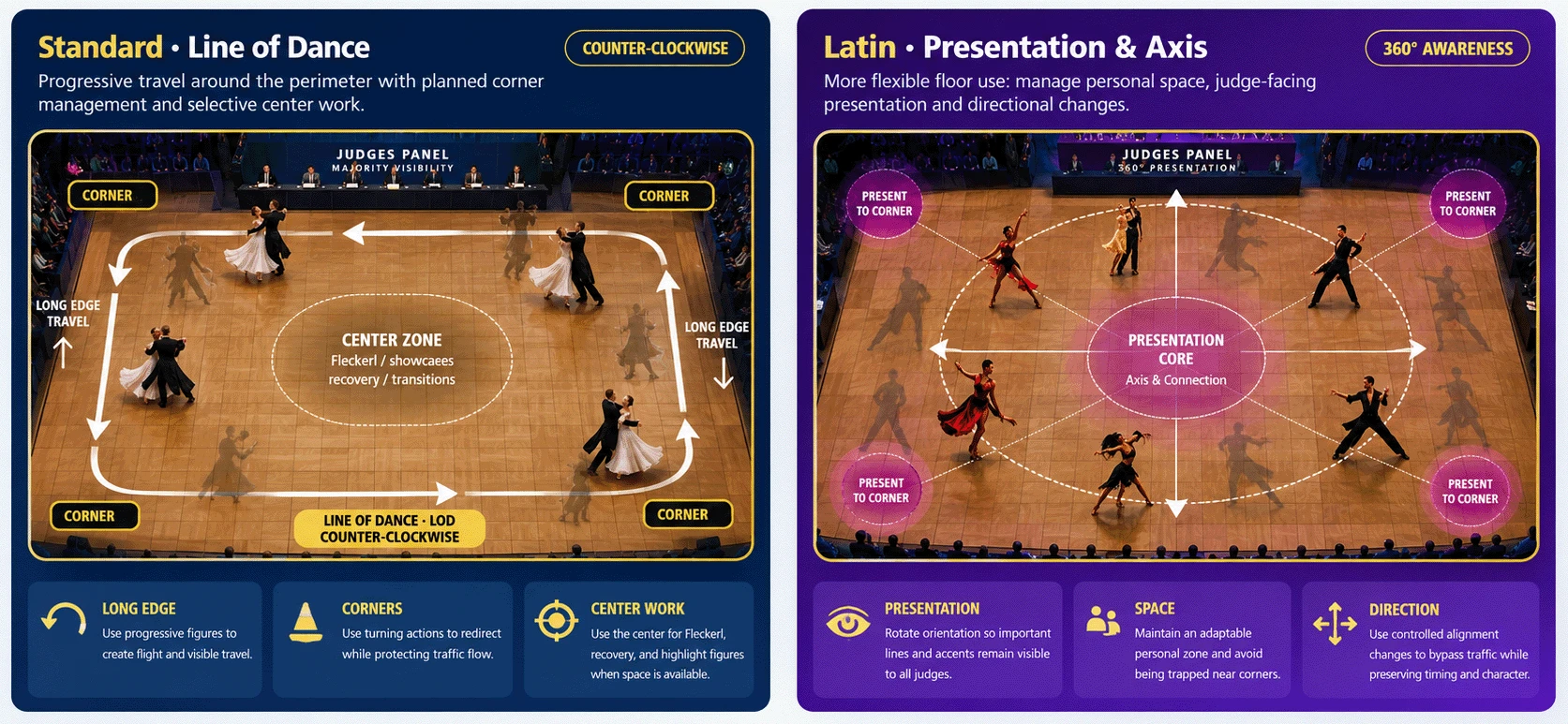
Authored planning reference for building the Standard routines. Waltz is now active; Tango and Slow Foxtrot remain timing references until their choreography datasets are supplied.
~28–30 MPM · 3/4
Approximately 43–45 measures per 90-second heat. Current authored routine: 45 measures.
~32 MPM · 2/4
Current authored routine: 48 measures / 90 seconds / 25 sequences, with S/Q timing retained in the routine table.
~28 MPM · 4/4
Current authored routine: 42 measures / 90 seconds / 29 sequences, with half-measure phrasing preserved.
~50 MPM · 4/4
Current authored routine: 75 measures / 90 seconds / 54 sequences, with S/Q and syncopated timing retained.
~58–60 MPM · 3/4
Current authored Open routine: 88 measures / ~90 seconds / 36 sequences, using Basic plus WDSF Open Level 1–3 labels.
Supporting guidance for executing the full Cha Cha · Samba · Rumba · Paso Doble · Jive round: syllabus discipline, floor craft, tactical positioning and stamina pacing.
Samba & Paso Doble: organize progression counter-clockwise along the Line of Dance.
Cha Cha · Rumba · Jive: treat the choreography as stationary/axis-based rather than following a fixed Line of Dance.
| Dance | Energy Output | Primary Focus | Conservation Strategy |
|---|---|---|---|
| 1 · Cha Cha | 80% | Crisp rhythm · sharp speed · clean leg actions | Establish presence early; prioritize sharp feet rather than excessive spatial coverage. |
| 2 · Samba | 90% | Bounce · continuous progression · stamina | Let ankles and knees absorb bounce naturally; avoid unnecessary upper-body tension through Volta sections. |
| 3 · Rumba | 60% · Active Recovery | Weight transfer · hip action · extension | Control breathing through holds and softer Cuban actions while maintaining presentation intensity. |
| 4 · Paso Doble | 85% | Posture · dramatic phrasing · accents | Generate power through posture and shape; reserve explosive output for Highlight 1 and Highlight 2. |
| 5 · Jive | 100% | Elasticity · speed · kick action · finish | Commit remaining energy while driving through weight transfer rather than excessive knee lift. |